Showing posts with label recipe. Show all posts

Thursday, May 18, 2017

Natural Bug Repellent


Working in the garden can be buggy business.  Using herbal essential oils suspended in water is a perfect way to chase the bugs away while gardening or other outdoor activities.


There are several essential oils (these are oils extracted through distillation from plant material - the concentrated natural essence that give plants their scent) that work well at chasing insects.

  • Lavender Essential Oil - an insect repellant that soothes, calms and heals the skin.  It can relieve the pain and redness of insect bites too.
  • Peppermint Essential Oil - repels insects and stimulates your senses and your circulation, while disinfecting your skin.  It can also relieve the itch of insect bites.
  • Lemongrass Essential Oil - uplifting and cleansing lemongrass is the best insect repellent oil.


Natural Bug Repellent Spray
Safe for the whole family, including children and pets, you can spray often, both yourself and the surrounding areas to keep bugs at bay.  It is both cooling and refreshing as well as effective on bugs.

4 ounces of distilled or spring water
10 drops lavender essential oil
10 drops lemongrass essential oil
10 drops peppermint essential oil

Mix ingredients together in a 4 ounce spray bottle. Shake well to mix.

TO USE: spray on skin and clothes, hair and hats.  Use often for maximum effectiveness, especially on a warm sunny day.

Alternatives- you can add this essential oil combination to sun screen or body oil to also use as a repellent.

NOTE-- use only 100% pure essential oil, not scented oil, potpourri oil or bath oil.  These are not the same.  NEVER place essential oil in direct contact with skin unless diluted in another medium. Contact toxicity is possible that way.

Sunday, November 9, 2014

Celeriac Gratin a Thanksgiving Recipe

One of the plants I grew this season for the first time was Celeriac or celery root.  It was easy to grow, you plant it and forget about it and harvest int he fall.

It was totally bug resistant, grew well and needed watering only occasionally.
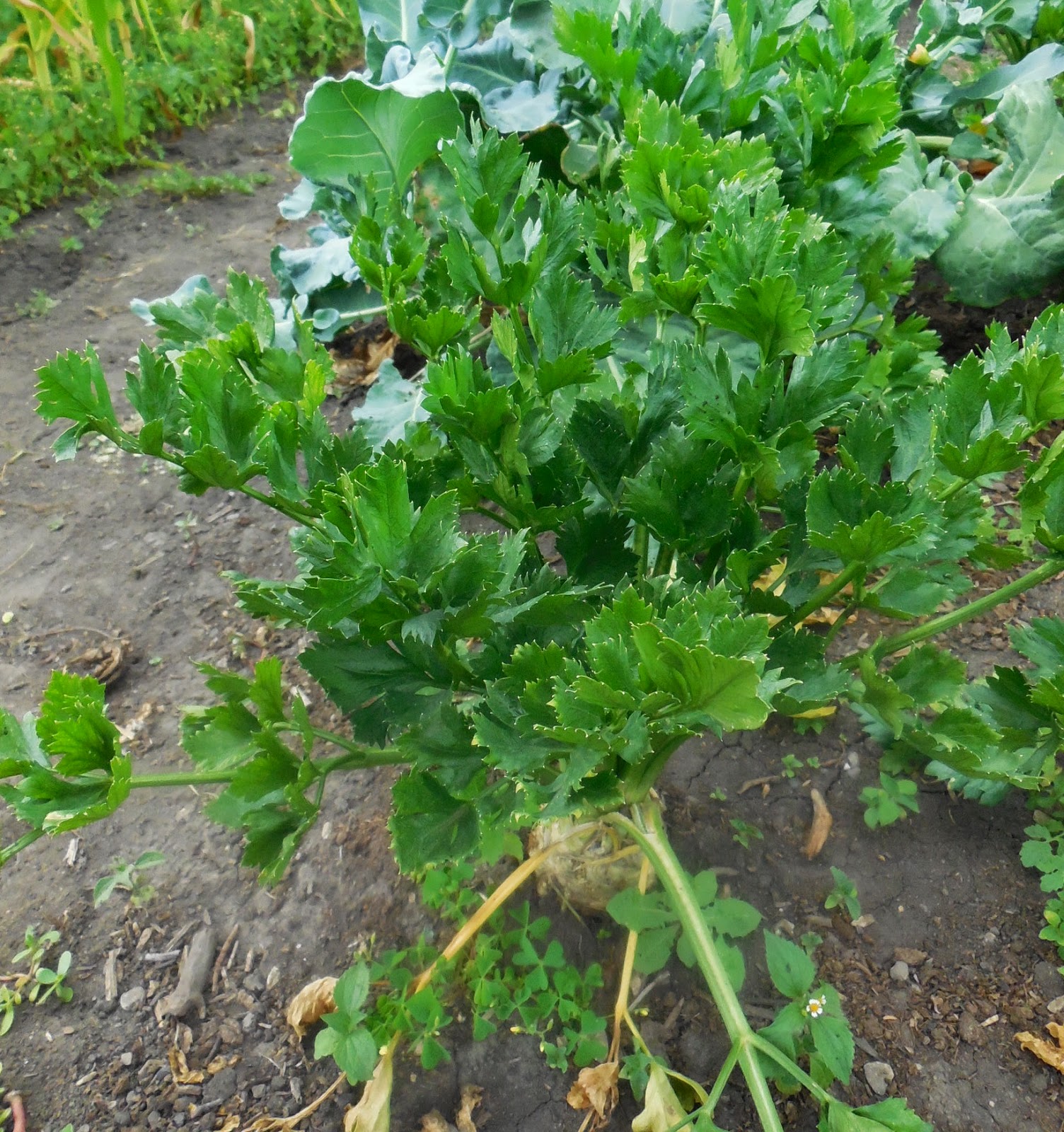
You can see the leaves and bulb in this early August 2014 photo
I would recommend it.  I even harvested the leaves from it to put in soups and stews and sauces and that was good too, even though the books said it might not be.

Leaves, photo taken in late July 2014
This is a recipe I found that we tried with the last two roots we harvested just before the first frost in late October 2014. (Full recipe at the bottom of the post!)

First step was to soften the peeled Celeriac which was done by simmering it in chicken broth and cream for about 30 minutes until the celeriac was tender.

After that the bulbs were cut into potato-like slices to go into the casserole dish.
 Now place the slices in the casserole with the thyme.
Bring the sauce to a boil and add the other ingredients to it.  Simmer for a bit then place it over the prepared celery root.  Do not worry if it looks like soup over the root it is supposed to.

Now grate the cheese.  We used a small food processor, but you can also do it by hand with a grater.


 Spread the Cheese over the prepared root in the casserole and bake for about 30 to 40 minutes, until the cheese has browned the the sauce is burbling.
 

What you get is a rich side dish, without the heavy starch flavor of potatoes.  It was perfect with the pork chops we had for dinner that night and with the nut crusted chicken breast we had the next night.  The cooking in the broth made the root soft and tasty and not tough.  This is a dish you could serve at Thanksgiving without any complaints!

Celeriac Gratin
  • 1 cup chicken broth
  • 2 cups heavy cream
  • 2 large celery roots (celeriac bulbs)
  • 2 tablespoons whole-grain Dijon mustard
  • 1 teaspoon sea salt
  • Freshly ground pepper, to taste
  • 1 teaspoon fresh thyme leaves
  • 1 cup finely grated Gruyere cheese

Directions:
In a large pot, bring vegetable broth and cream to a simmer. Trim the ends of your celeriac and use a sharp knife to peel the bulb. (Don't bother with a vegetable peeler, the tough skin needs something sharper.) When the bulbs are peeled, quarter each bulb, lengthwise. Add celeriac to the pot of simmering liquid. Cover and cook, turning occasionally, until the celeriac is tender (about 30 mins).

Heat oven to 350 degrees.  Remove pot from heat. Use a slotted spoon to transfer celeriac pieces to a large cutting board. When cool enough to handle, slice the celeriac into 1/4-inch-thick slices.

Layer the sliced celeriac in the bottom of an ungreased baking dish. Worry some over creating a pretty design, but not too much. Sprinkle with fresh thyme leaves. Bring the liquid remaining in the pot to a boil (watching carefully to make sure it doesn't boil over). As the liquid thickens, add mustard, salt, and pepper to taste. Pour the mixture over the layered celeriac, covering completely (if it looks soupy, all the better). Sprinkle the cheese evenly over the top, covering completely. Garnish with a sprig or two of thyme and bake for from 35 to 40 minutes, until the liquid is burbling and the cheese has turned richly golden-brown. Serve hot.


Notes: You can substitute a rich vegetable broth instead of chicken broth. Cooking the celeriac in the broth prior to baking gives it a rich flavor and ensures that the root vegetable won't be tough or stringy after baking.

Monday, September 15, 2014

Carrot & Kohlrabi Slaw recipe

Carrot & Kohlrabi slaw
Chik-fil-a used to sell (in Illinois anyway) a great carrot salad, which I have since learned is actually of French origin.  Recently I saw a recipe for carrot and kohlrabi slaw that made me think, this is what I can do with the plants I added late in the season to my garden. Grated kohlrabi gives this carrot salad a peppery, crisp edge.

2 bulbs kohlrabi
4 carrots
3 Tbsp. vegetable oil
2 Tbsp. cider vinegar
1 Tbsp. whole grain or Dijon-style mustard
1/2 tsp. sea salt
Freshly ground black pepper to taste

Directions:
Peel kohlrabi and carrots. Be sure to cut off all of the tough outer peel of the kohlrabi. Set them aside. In a salad bowl, whisk together the oil, vinegar, mustard and salt until well blended. Add pepper, if you like. Using the large holes on a standing grater or a mandoline set up for fine julienne, grate the kohlrabies and the carrots into the salad bowl. Toss everything together until the kohlrabi and carrot are evenly coated with the dressing. Taste and add more salt or pepper, if you'd like.


Marcy notes: Since I recently obtained a mandoline I decided to use it to make julienne slaw pieces rather than using my grater.  The texture is much firmer this way.

Saturday, August 30, 2014

Cutting your Zucchini

Zucchini is prolific in a garden even if you only have three plants like I do.  We grew ours from seed.  Placed thee seeds in a hill and thinned them to one plant in each hill.  However, they still grew large and spread into the path and are covered with blossoms and fruits.  We have about 5 so far and I am looking forward to using them.  I will share recipes and experiments as time goes on.

How you use your zucchini sometimes requires different treatment and I thought I would start with how to cut your zucchini first, then move into recipes later.

The first technique is to dice the zucchini


 If you are going to make soups or stews this is the perfect bite size.

Shredding your zucchini with a box grater or food processor

This technique creates threads you can use in slaws, lasagna, omelets,
add to ground meat in your meatloaf, or to make breads. If you want to make sure your finished product is not water, sprinkle the zucchini with
salt to draw out the excess moisture then rinse and pat dry before
adding to slaws and other similar dishes.


You can slice your zucchini crosswize to create disks.
These shapes are great in stir fry, casseroles, any scalloped dish,  or a meat and veggie saute.  You can also slice on the diagonal to get a more oval shape.This is the shape I use for my Zucchini sweet pickles, but I cut them rather thin.


If you want to grill, cut 1/2 inch thick planks.

This is a great way to use the really large zucchini you get later in the season.

Sticks of zucchini

These 1/2 inch by 3/4 inch sticks or spears are great if you are making pickles, or veggie fries.  This is also a sturdy shape for deep frying.

If you have a mandoline you can cut your zucchini in Julienne strips.

This is great in salads raw or steamed and used in or as a side dish.  This is also a great way to reduce the tough tooth feel of an older more mature zucchini so you can use it in a stir fry or saute.

A potato peeler can let you shave off ribbons of zucchini.

This will help avoid the seedy center in larger fruits.  You can then take these thin pieces and marinade them in lemon juice and olive oil to make a vegetarian carpaccio or steam them to craft a zucchini fettuccine.

Carpaccio is a rare beef dish that uses thin slices of meat served over arugula and spinach with shaved parmesean cheese.  You can simply substitute the the zucchini for the beef and drizzle lemon juice and olive oil over it all and sprinkle with fresh pepper and serve. Or you can use your favorite vinaigrette.


Sunday, August 3, 2014

Recipe - Zucchini Oatmeal Bread

With six Zucchini sitting on the counter I knew I needed to do something to use them up so I decided on Zucchini bread.  It is a quick and tasty way to use zucchini and its easy too.  I have collected many recipes and tried out three, the best we made more of.  This recipes caught my eye because of the oats which would give it more substance and make it a good bread to freeze.


I made six loaves of this recipe along with two loaves each of two other recipes.  All were tasty and perfect with a bit of butter and glass of lemonade.  This version was our favorite however, so I decided to share it with you.  I have several other recipes for zucchini bread yet to try and since I made 10 loaves and only used 4 zucchini we still have plenty left to experiment with.

Zucchini Oatmeal Bread

3 eggs
2 cups sugar
1 cup vegetable or canola oil
1 Tbls.Vanilla extract
1 cup quick Rolled Oats
2 cups flour
¼ tsp. baking powder
1 tsp. baking soda
1 tsp. salt
2 cups grated zucchini
1 cup chopped nuts (optional)

Beat eggs and sugar. Add oil and vanilla. Mix in oats, flour, baking soda, salt and baking powder. Add zucchini and nuts. Mix well. Pour into two greased and floured 8 x 4 loaf pans.  Bake at 350 for 1 hour.

Two quick full-sized loaves

Sunday, June 22, 2014

Making Salad from the Garden

So far we do not have any fresh tomatoes so I had to get them from the farmers market, but the plants have flowered and the pollinators are out so it is just a mater of time.  However the salad greens and the peppers were available so I harvested that.

salad greens
I collected butter crunch lettuce, sorrel, mustard greens, and micro greens.  We washed and drained them , then tore them by hand into a bowl.  (Please remember my camera is broken, so I cannot turn on the flash, making indoor picture difficult.)


We added tomatoes, green onions and carrots from the farmer's market and gathered fresh herbs from the garden to made an herbal dressing to go on top.

Creamy Herb Dressing
1 cup extra virgin olive oil
1/2 cup buttermilk
1/4 cup fresh parsley, minced
1/4 cup fresh basil, minced
3 tablespoons herb vinegar (any combo of herbs is good)
2 tablespoons water
2 tablespoons fresh thyme, minced
1 tablespoon fresh chives, minced
1 tablespoon complementary herbed honey (plain honey is fine too!)
1 green onion, thinly sliced
1 teaspoon Dijon mustard


Combine all ingredients in a blender and process until smooth. For a more emulsified dressing, blend all ingredients except oil, then slowly drizzle in the oil with the blender running. Cover and chill for several hours before using to allow flavors to blend.  Cover tightly and store in the refrigerator.