Showing posts with label tomato care. Show all posts

Thursday, June 4, 2015

Planting Tomatoes and Peppers

We used the same method for planting both the tomatoes and peppers. We did not grow the plants from seed, rather we bought seedlings at a plant sale at the beginning of May.  As someone who lives in an apartment I do not start plants from seed indoors.

The Technique

The best way to plant vegetables is first to lay them out with the proper spacing.  Tomatoes need between 18 ans 24 inches of space.  Peppers need only 18 to 20 inches of space around the plants.


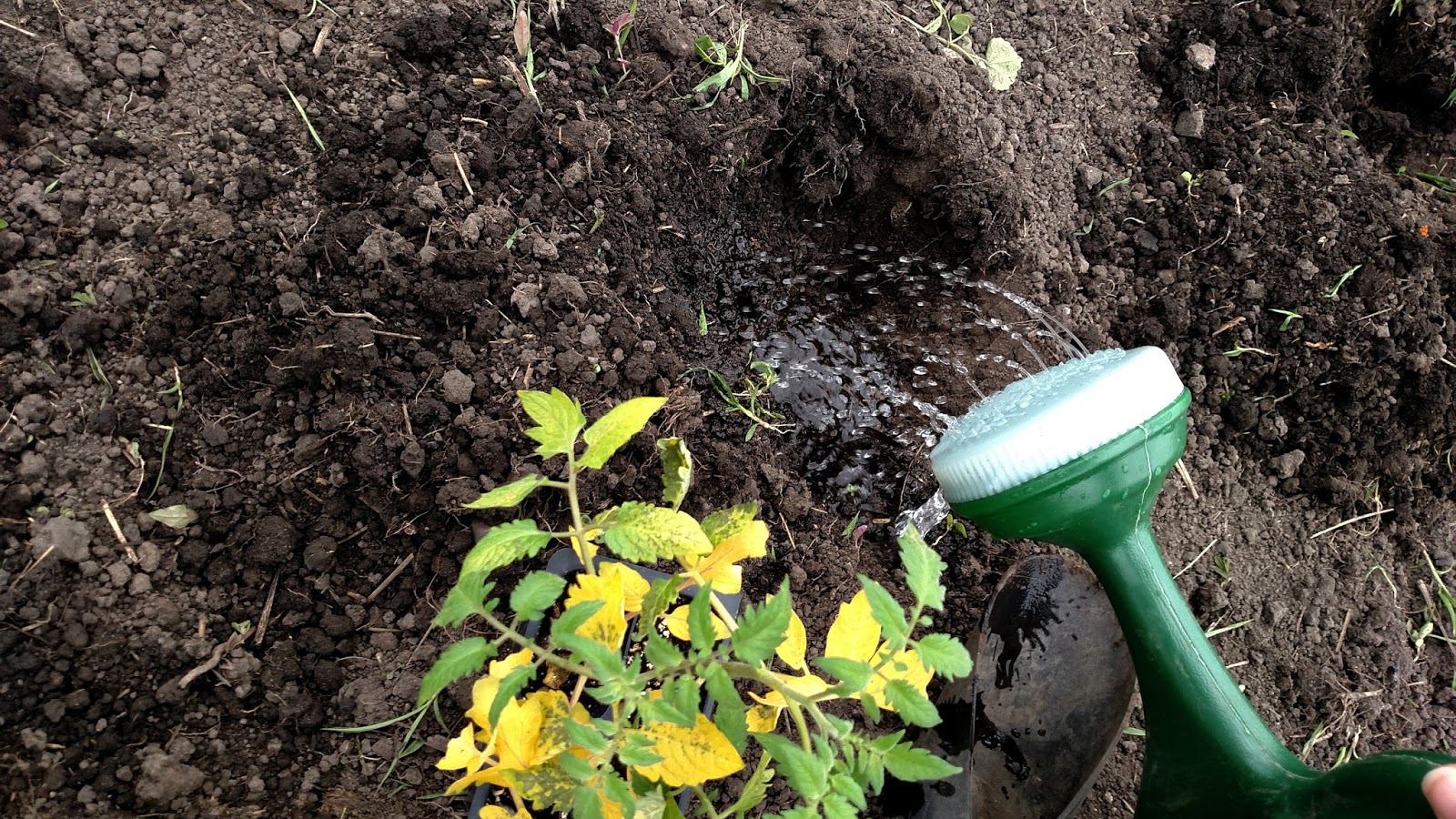
A hole is dug twice as large and twice as deep as the root ball of the plant.  I fill the hole with water and allow it to percolate into the soil, This tells me if the soil drains well and also wets the soil so that the root is not dried out when buried.


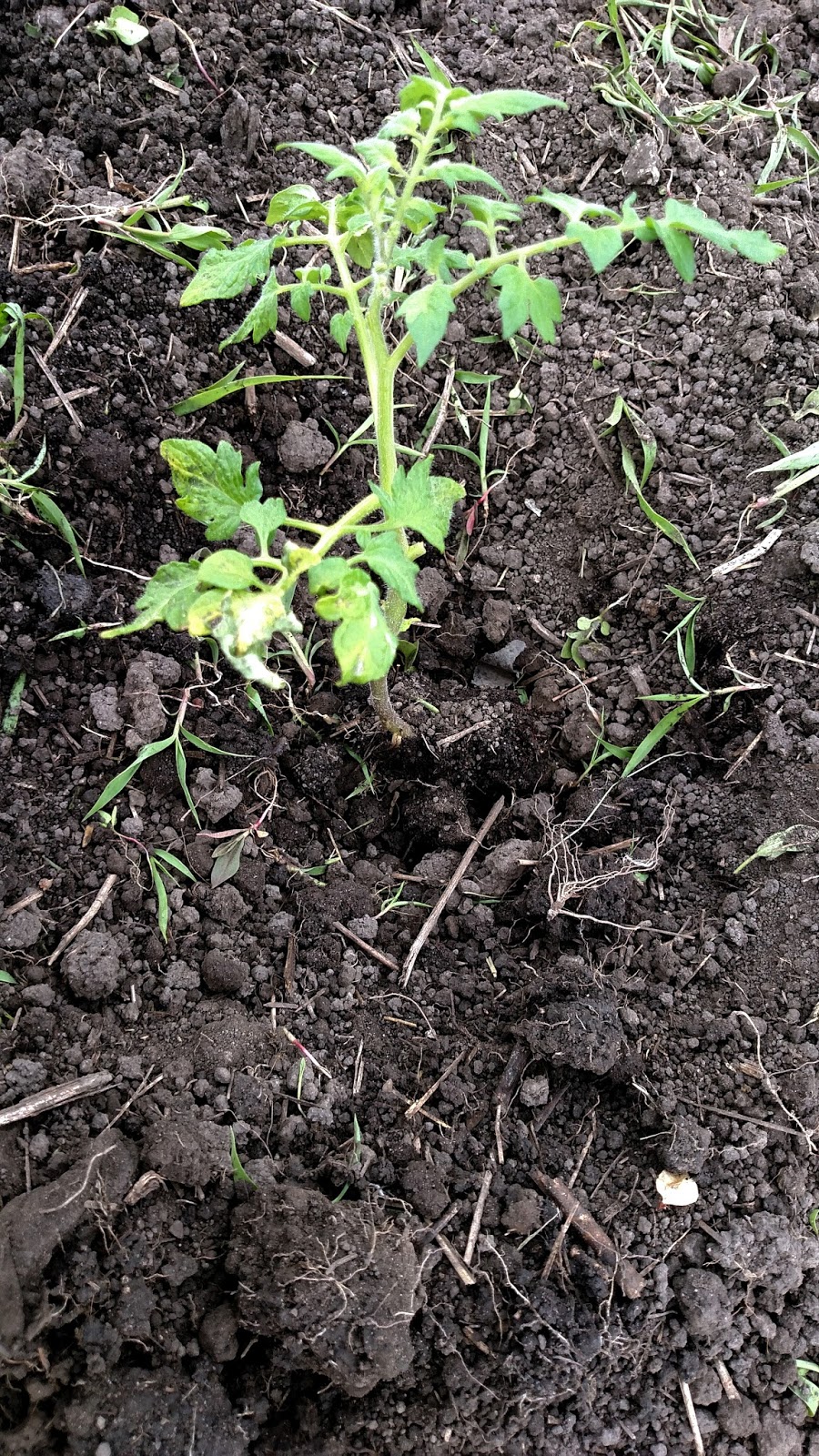
Before placing the plant in the hole I toss in a handful of compost to give the plant a bit of a boost to off set the shock of being planted.  The finally the plant is placed in the hole and the soil firmed around the plant.  It is then water thoroughly.


Once all the plants were planted I gave them a top dressing of more compost.


We could have waited a couple of weeks to put up the cages, as the plants hardly need them now, but we decided to just stake and cage them now in case we had warm nights that would cause rapid growth.


We would have watered them one more time before leaving the garden, but rain was predicted that night so we did not.  Good thing, as it rained for several hours that night.

Saturday, August 9, 2014

Tomato Disease Issues in the Garden

As I have posted in the weekly updates we have several tomato issues in the garden.  I have been researching these issues and have come up with the following information.

GROWTH CRACKS

Growth cracks result from extremely rapid fruit growth. This may be brought on by periods of abundant rain and high temperatures, or can occur when water is suddenly available to the plant through rain or irrigation after a period of drought. Cracks may radiate from the stem end of the fruit or may encircle the fruit. Cracks are often invaded by secondary fungi and bacteria that further rot the fruit.

Maintaining even moisture by watering regularly and mulching the soil around the tomato plant can help reduce growth cracks. Varieties differ in susceptibility to cracking, and variety descriptions may be helpful in choosing a plant less likely to crack.  Heirloom tomatoes are most susceptible to growth cracks.  I still like them even though,due to our heavy rains, we have many growth cracks this year.

BLOSSOM END ROT

Among the problems we have seen with our tomatoes is blossom end rot.  This is very common among Roma tomatoes.   Affected fruit have a tan to black flattened spot at the blossom end of the fruit. Secondary fungi and bacteria can enter the blossom end rot area, resulting in further decay of the fruit. Blossom end rot can appear on fruit in any stage of development, but it is most common when fruit are one-third to one-half grown. The first fruit produced by the plant are often most severely affected. Fruit that develop later in the season on the same plant can be unaffected. I generally, in the past, ignored this problem unless it became so rampant that I did not get enough fruit.  I was warned that some people believed there were calcium problems in the soil of the Community Garden and the cause of blossom end rot is calcium deficiency in the tomato plant. Although blossom end rot means that the plant does not have enough calcium within the developing fruit, it does not mean that there is a lack of calcium in the soil. Often blossom end rot occurs as a result of several cultural or environmental factors that affect the plants ability to take up calcium. Fluctuations in soil moisture, heavy applications of nitrogen fertilizer, and injured roots can all predispose tomato plants to blossom end rot.


blossom-end-rot
Blossom end rot, M. Grabowski
The amount of calcium salt available to the plant decreases rapidly in the presence of excessive salts such as potassium, magnesium, ammonium, and sodium. Extreme fluctuation in moisture can also reduce the availability of calcium salts needed by the plant. Heavy applications of nitrogen fertilizers and abundant rain cause rapid and luxuriant plant growth and predispose the fruit to blossom-end rot, especially during periods of dry, hot weather.
Blossom-end rot can be minimized by maintaining a uniform supply of moisture through regular watering and soil mulches, applying fertilizer according to the results of a soil test, and avoiding root injury by not cultivating within 1 foot of the base of the plant.

Although we have blossom end rot on a few plants it is not wide spread and can be linked to the heavy rains we had so is not unexpected.  I just pick the damaged fruit and dispose of it.

VERTICILLIUM WILT
Probably verticillium wilt
However among the plants we have other symptoms such as spotted and dying leaves.  So my first thought was we might have Verticillium wilt.  This is a common fungus and I have seen it before in my herbs and my maple trees. The fungi causing this disease overwinter in the soil as mycelium or on plant debris as microsclerotia. The fungi infect a susceptible host through wounds in the roots caused by cultivation, nematodes (microscopic worms), or the formation of secondary roots. This disease is considered a cool-weather disease, developing between 65° and 83°F.  Since we had a very cool start to the season I thought this was a great disease to start with in my research.


verticillium wilt


Diseased plants often have only a portion of the plant wilting, such as one or two stems rather than the whole plant, but it will be a whole section of a plant, not a few leaves or branches.  The look of my tomato plants is a bit different than what is expected in Verticillium wilt.  However, my search here took we to other fungal diseases that lay dormant in the soil and that was when I discovered early blight.

EARLY BLIGHT


Early blight is a common tomato disease caused by the fungus Alternaria solani. It can affect almost all parts of the tomato plants, including the leaves, stems and fruits. The plants may not die, but they will be weakened and will set fewer tomatoes than normal. Early blight generally attacks older plants, but it can also occur on seedlings. Stressed plants or plants in poor health are especially susceptible. Early blight is also a problem with potatoes.

Symptoms: Dark spots with concentric rings develop on older leaves first. The surrounding leaf area may turn yellow. Affected leaves may die prematurely, exposing the fruits to sun scald.

Early Blight fungus overwinters in plant residue and is soil-borne. It can also come in on transplants. Remove affected plants and thoroughly clean fall garden debris. Wet weather and stressed plants increase likelihood of attack. Copper and/or sulfur sprays can prevent further development of the fungus. 

The best treatment for this is to rotate crops.  It can take 4 to 6 years to work out of the soil.  And it comes from infected plant material not being removed as well as coming in on seedlings and compost materials imported from other locations.  In other words all the ways people grow plants in a community garden increases the potential for this disease to be present.  There are no good ways to treat for this fungus in a home garden so the best treatment is disease resistant plants.  


Here is a list of some resistant plants: 

Aunt Ginny's Purple - Heirloom, indeterminate, beefsteak (16 oz.) 
Big Rainbow
 - Heirloom, indeterminate, bi-color beefsteak (16 oz.) 
Black Plum
 - Heirloom, indeterminate, plum (2 in.) 
Juliet
 - Hybrid, indeterminate, cherry (1 ounce) 
Legend
 - Open-pollinated, determinate, beefsteak (14-16 ounces) 
Manyel
 - Heirloom, indeterminate, yellow globe (8-10 ounces) 
Matt’s Wild Cherry
 - Heirloom, indeterminate, cherry (1/2 inch) 
Mountain Supreme
 - Hybrid, determinate, globe (6-8 oz.) 
Mountain Fresh Plus
 - Hybrid, determinate, globe (12 ounces) 
Old Brooks
 - Heirloom, indeterminate, globe (6-8 ounces) 
Tigerella
 (aka Mr. Stripey) - Heirloom, indeterminate, globe (4-6 oz.) 
Tommy Toe
 - Heirloom, indeterminate, cherry (1 inch)

Resources:
        Identifying Diseases of Vegetables, by MacNab, Sherf and Springer, Penn State, 1983 
   University of Minnesota Extension service website 
         http://www.extension.umn.edu/garden/yard-garden/vegetables/#tomatoes
Texas A&M Agrilife Extension website
      http://aggie-horticulture.tamu.edu/vegetable/problem-solvers/tomato-problem-solver/

Wednesday, July 16, 2014

weekly update - July 14 - Tying Tomatoes

On July 13 I was selling my wares (see www.backyardpatch.blogspot.com) so I went out the garden on Monday and Tuesday instead.  There was a lot of rain this past week.  So much so that I did not need to water and the weeds did grow a bit from my lack of need to go to the garden.

taken 7-15-14
Everything is looking very green and really beginning to show growth.  The lettuces are going to seed and some will need to be removed soon.  The beans are climbing the trellis nicely and cucumbers and squash are blooming and beginning to produce.

acorn squash bearing fruit
Nice crop of beans
peas growing well - dwarf variety still getting rather tall
first zucchini

Tasks this week

The big task this week was to tie up the tomato plants that are not in cages.  We caged the better boy and the heirloom tomatoes just after planting back in May, but the smaller grape and cherry tomatoes I waited to see  what they would need.  We salvaged wood from a dumpster for this.  I could not believe our luck but the art museum must have been cleaning out a store room as they tossed 2 x 4s and thinner 1 x 2 that looked almost new and were 6 to 8 feet long.  We were able to create stakes 3 feet long for each of the tomato plants.

Chas did all the lumber cutting and placement of the stakes.  My job was to go back through and tie everything up.  I use a cotton twine for this.  the same twine I used for marking seed rows and creating trellis for peas and beans.

I quadrupled the twine and twisted the strands together to create a wide enough material that it would not cut into the branches of the plants. I tied each plant with at least two ties.  One near the base and one just above halfway up.  If the plants get taller, I have room for one more set of ties.


Now the tomatoes are upright, you can clearly see the basil and all the weeds we missed.

I removed the arugula and the butter crunch lettuce that we had not harvested.  The arugula was a target for pests and all the leaves were perforated with holes so I never harvested it in any great amount.  Once it started to go to seed i removed it to the compost bin.  The butter crunch went to seed when the weather turned hot after all that rain.  There was only one head of it left so I removed that to compost as well.  the mustard i am letting go to seed for the seed.  the micro green are still able to be harvest and the sorrel will be good for another month or more of harvesting.

In place of the lettuces removed we planted some Kohlrabi that was given to us by a friend.  I used the same planting technique as before, digging a hole twice as wide as the root ball, filling it with water and letting that soak in before placing the plant in and firming the soil.  They will be rather late in the year before we can harvest these, but we will see how they do.


Issues to address

The tomatoes plants are definitely dying back along the bottom.  I would have said this was due tot lack of sun, but I think it is something else as this garden gets more sun than any I have ever planted in.


There are some who say the soil suffers from a lack of calcium which is easily fixed.  The large amounts of rain we have had are going to cause a few other problems too I expect, like blossom end rot and black spot.

Monday, July 7, 2014

Weekly update - July 6

The holiday weekend arrived and we decided to go away ,so we stopped by the garden on the morning of July 2 and watered it very well.  Then we did not come back until July 6.  I think the garden fared very well, don't you?

Several early plants are producing seed now. I will allow them to go to seed either to use or save the seeds.  First seed is Dill.  You can see the seed heads are nicely formed.  We will see if the birds leave them alone.
Dill going into flower


Several of the greens are finished producing as the heat has made them bolt.  Arugula and mustard are being allowed to go to seed so I can save the seed for next year and use the seed to make my own mustard respectively.

The Broccoli Rabe is starting to produce.  In some ways they look exactly like regular broccoli, but the heads are not as compact or as large.  To harvest you just break the stem and leaves of near the central  stalk,  the stems are softer and more edible than traditional broccoli so you can eat and stir fry and such with it.  I find the taste to be slightly sweeter than regular broccoli.

The dwarf peas have gone into flower and I hope will produce peas soon.  I don't eat them so this is strictly for the husband.

There are just the starts of acorn squash too.  I can see that this garden is finally going to be a producer of many vegetables.  The slow start to the season was really beginning to make me doubt we would enjoy any fruits of our labor, but not we are getting into the full swing.

The beans are budding too so I hope to get a nice crop of both fresh beans and dried beans.  The climbers are beans that I want to dry the bush I hope to make into many dishes.


Problems Noticed

We are growing our vegetables with no chemicals.  I cannot say we are organic, because I know that some of the gardeners around us are using pesticides and such, but we are not.  As a result, however, we are getting some bug damage to the plants.  We are hoping that once our companion plants begin to flower, some of the pests will be repelled.

For now we noticed damage to the tomatoes.


There is also this wilting that is occurring on the bottom branches of the tomatoes.  I removed a number of the lowest branches in the hope that if this wilt was something in the soil (I had been warned about it) it would be helped by removing the branches.  and although it took my plants longer to develop it than those gardening around me, I still have it.  It does not seem to be effecting the growth of tomatoes as you can see by these romas producing nicely.


This plant looks like it is dead, but it is not, however, you can see the blossom end rot on the upper tomato.  I decided to removed the wilted branches giving the healthy branches better sun light.  So far the plant is not dead.

We have still gotten good rain and the sun in this patch is perfect, so if the evenings willjust warm up I think we will have a nice crop of Tomatoes from all the various bushes.  Peppers are slow to get going, but I still hold out hope.