Showing posts with label Community Garden. Show all posts

Tuesday, March 28, 2017

Working in a community Garden again!

2015 Community Garden plot
In 2015 we moved from our apartment to a house and when we changed communities we had to give up our community garden.  I did put in raised beds in our yard so if you want to see the gardens from the 2016 season, check out my other blog where I posted an update each month:

May
June
July
August
September


2016 backyard raised beds
In 2017 however, the village of Villa Park where we now live, is putting in Community Gardens for the first time and the garden club that I belong to is in Villa Park so we are putting in a demonstration plot where we will try techniques and illustrate ideas for other gardeners.  I thought it would be great to document that community garden here.  So follow us in the 2017 season as the Garden Club of Villa Park works in its community garden.  I hope to interview other community gardeners in the plots and see what there experiences are as well.

We will be doing gardening lectures at the Villa Park Library all summer, so I will post information from those lectures and other related information too!

Stay tuned in the next month for plant suggestions, recipes and other things to get you into the gardening spirit.

Wednesday, June 17, 2015

Watering Plants for Healthy Growth - or what to do if you are not flooding

As I pointed out it rained after I put the plants into the "other Community Garden."  Then it rained the next day and the next, and the next, then on July 15 we received a storm that exceeded the average rainfall for the month.

This week we received 7 to 8 inches of rain.  Five inches fell on June 15.  The locally heavy storm flooded streets where I live so badly it actually made the national news and was mentioned on NPR, most probably because the rain was worst between 4:45 and 5:15 in the midst of rush hour.  Being a Chicago suburb this resulted in stranded motorists on the local freeway.
lots of streets in Elmhurst looked like this.
Last year we had a similar hard rain event, but then it came in late July and was followed by several other heavy rains that eventually resulted in our growing season ending early.

That white sign in the middle  is on the underpass, normally  15 feet from the street, seen here filled with water.
This month at O’Hare Airport  there has been 4.36 inches of rain as of 6/16/15, the average rainfall in the month of June is 3.5 inches, so we are halfway through the month and have exceeded the rainfall for the month and with Tropical storm Bill hitting Texas this week we can expect more rain next week and storms are already predicted for Thursday.
East End Park (near garden plots)
I have not been to the garden.  The roads leading to it were closed this week (Have I mentioned that the City wanted to turn the area around the gardens into flood retention as it already floods terribly?) I suspect there is still some standing water on the gardens, but I guess I do not want to know.  The photo above was taken at the park near the garden plots.

With all this extra water, we have not had to figure out if our hose reaches far enough to allow us to easily water the garden.  We’ve never hooked it up.  But not everyone is having this excess, so I thought I would take a moment to speak about how and when to water your garden. There are a range of factors which determine the best way to water each plant.

Watering your Garden

The Old Farmers Almanac, part of growveg.com, has a short, sweet, informative video on watering your garden. 

Here are the highlights:
You want to encourage plants to produce deeper roots that will seek out water deeper in the soil, however frequent watering causes plants to create shallow roots which are more affected by dry spells. Thorough watering once a week is better than shallow watering every two days.

Seedlings need more water until they can produce their own root systems.

Squashes, cucumbers, beans and peas need a bit more water when they are producing flowers and fruits.
Root vegetable crops like parsnips and carrots need less water as they are the tap root.

Water close to the ground trying to avoid wetting the foliage as this promotes disease.

Never water in the middle of the day as much of the water will quickly evaporate.

Do not be fooled by the dry surface.  Grab a trowel and dig into the soil to see if it is actually wet underneath.  If the soil near the roots still clumps when you squeeze it, put off watering for another day.
Drip irrigation is always best for a garden, but in a community garden this is usually not possible, so instead try deep watering containers


Plastic one pint milk bottles or dry drink mix containers from Aldi make great long time waterers if you poke holes in the bottom and bury them in the ground near plants.  Filled with water, they will slowly drip down into the soil by the roots of plants rather than watering at the surface.

Saturday, August 9, 2014

Tomato Disease Issues in the Garden

As I have posted in the weekly updates we have several tomato issues in the garden.  I have been researching these issues and have come up with the following information.

GROWTH CRACKS

Growth cracks result from extremely rapid fruit growth. This may be brought on by periods of abundant rain and high temperatures, or can occur when water is suddenly available to the plant through rain or irrigation after a period of drought. Cracks may radiate from the stem end of the fruit or may encircle the fruit. Cracks are often invaded by secondary fungi and bacteria that further rot the fruit.

Maintaining even moisture by watering regularly and mulching the soil around the tomato plant can help reduce growth cracks. Varieties differ in susceptibility to cracking, and variety descriptions may be helpful in choosing a plant less likely to crack.  Heirloom tomatoes are most susceptible to growth cracks.  I still like them even though,due to our heavy rains, we have many growth cracks this year.

BLOSSOM END ROT

Among the problems we have seen with our tomatoes is blossom end rot.  This is very common among Roma tomatoes.   Affected fruit have a tan to black flattened spot at the blossom end of the fruit. Secondary fungi and bacteria can enter the blossom end rot area, resulting in further decay of the fruit. Blossom end rot can appear on fruit in any stage of development, but it is most common when fruit are one-third to one-half grown. The first fruit produced by the plant are often most severely affected. Fruit that develop later in the season on the same plant can be unaffected. I generally, in the past, ignored this problem unless it became so rampant that I did not get enough fruit.  I was warned that some people believed there were calcium problems in the soil of the Community Garden and the cause of blossom end rot is calcium deficiency in the tomato plant. Although blossom end rot means that the plant does not have enough calcium within the developing fruit, it does not mean that there is a lack of calcium in the soil. Often blossom end rot occurs as a result of several cultural or environmental factors that affect the plants ability to take up calcium. Fluctuations in soil moisture, heavy applications of nitrogen fertilizer, and injured roots can all predispose tomato plants to blossom end rot.


blossom-end-rot
Blossom end rot, M. Grabowski
The amount of calcium salt available to the plant decreases rapidly in the presence of excessive salts such as potassium, magnesium, ammonium, and sodium. Extreme fluctuation in moisture can also reduce the availability of calcium salts needed by the plant. Heavy applications of nitrogen fertilizers and abundant rain cause rapid and luxuriant plant growth and predispose the fruit to blossom-end rot, especially during periods of dry, hot weather.
Blossom-end rot can be minimized by maintaining a uniform supply of moisture through regular watering and soil mulches, applying fertilizer according to the results of a soil test, and avoiding root injury by not cultivating within 1 foot of the base of the plant.

Although we have blossom end rot on a few plants it is not wide spread and can be linked to the heavy rains we had so is not unexpected.  I just pick the damaged fruit and dispose of it.

VERTICILLIUM WILT
Probably verticillium wilt
However among the plants we have other symptoms such as spotted and dying leaves.  So my first thought was we might have Verticillium wilt.  This is a common fungus and I have seen it before in my herbs and my maple trees. The fungi causing this disease overwinter in the soil as mycelium or on plant debris as microsclerotia. The fungi infect a susceptible host through wounds in the roots caused by cultivation, nematodes (microscopic worms), or the formation of secondary roots. This disease is considered a cool-weather disease, developing between 65° and 83°F.  Since we had a very cool start to the season I thought this was a great disease to start with in my research.


verticillium wilt


Diseased plants often have only a portion of the plant wilting, such as one or two stems rather than the whole plant, but it will be a whole section of a plant, not a few leaves or branches.  The look of my tomato plants is a bit different than what is expected in Verticillium wilt.  However, my search here took we to other fungal diseases that lay dormant in the soil and that was when I discovered early blight.

EARLY BLIGHT


Early blight is a common tomato disease caused by the fungus Alternaria solani. It can affect almost all parts of the tomato plants, including the leaves, stems and fruits. The plants may not die, but they will be weakened and will set fewer tomatoes than normal. Early blight generally attacks older plants, but it can also occur on seedlings. Stressed plants or plants in poor health are especially susceptible. Early blight is also a problem with potatoes.

Symptoms: Dark spots with concentric rings develop on older leaves first. The surrounding leaf area may turn yellow. Affected leaves may die prematurely, exposing the fruits to sun scald.

Early Blight fungus overwinters in plant residue and is soil-borne. It can also come in on transplants. Remove affected plants and thoroughly clean fall garden debris. Wet weather and stressed plants increase likelihood of attack. Copper and/or sulfur sprays can prevent further development of the fungus. 

The best treatment for this is to rotate crops.  It can take 4 to 6 years to work out of the soil.  And it comes from infected plant material not being removed as well as coming in on seedlings and compost materials imported from other locations.  In other words all the ways people grow plants in a community garden increases the potential for this disease to be present.  There are no good ways to treat for this fungus in a home garden so the best treatment is disease resistant plants.  


Here is a list of some resistant plants: 

Aunt Ginny's Purple - Heirloom, indeterminate, beefsteak (16 oz.) 
Big Rainbow
 - Heirloom, indeterminate, bi-color beefsteak (16 oz.) 
Black Plum
 - Heirloom, indeterminate, plum (2 in.) 
Juliet
 - Hybrid, indeterminate, cherry (1 ounce) 
Legend
 - Open-pollinated, determinate, beefsteak (14-16 ounces) 
Manyel
 - Heirloom, indeterminate, yellow globe (8-10 ounces) 
Matt’s Wild Cherry
 - Heirloom, indeterminate, cherry (1/2 inch) 
Mountain Supreme
 - Hybrid, determinate, globe (6-8 oz.) 
Mountain Fresh Plus
 - Hybrid, determinate, globe (12 ounces) 
Old Brooks
 - Heirloom, indeterminate, globe (6-8 ounces) 
Tigerella
 (aka Mr. Stripey) - Heirloom, indeterminate, globe (4-6 oz.) 
Tommy Toe
 - Heirloom, indeterminate, cherry (1 inch)

Resources:
        Identifying Diseases of Vegetables, by MacNab, Sherf and Springer, Penn State, 1983 
   University of Minnesota Extension service website 
         http://www.extension.umn.edu/garden/yard-garden/vegetables/#tomatoes
Texas A&M Agrilife Extension website
      http://aggie-horticulture.tamu.edu/vegetable/problem-solvers/tomato-problem-solver/

Monday, June 9, 2014

Weekly Update of the Community Patch 6-8-14

This weekend was architecture days!  After the success of the raised bed, I was emboldened to finally put in the trellis materials the vegetable plants needed. So on Saturday I installed (with help from hubby) three different structures for the vegetables to grow on.

Here is the garden this week:


Here is week one (for comparison):


This week the big additions were the raised bed for the thyme, the trellis for the cucumber, the string frame for the peas and the rope pyramid for the pole beans. I detail these items in another post on Wednesday..

Additionally the plants are beginning to bush out, flower and bear fruit.  We have green peppers, hot peppers forming, flowers on the acorn squash and tomatoes, and we were able to harvest greens for a salad this week.  To taste the first fruits is a wonderful experience.  Look to the bottom for a recipe for dressing I made to go on the greens.

The greens are doing very well and we were able to cut some of all of them to eat.


We finally have neighbors.  I guess the person who originally took the space next to mine had to decline and someone new has moved in, but she has a lot of weed work to do.  You can see she is slowly working her way from the back to the front and has a patch already cleared.


The melon and the zucchini were both attacked by the cucumber beetles, so I was glad that I waited to thin them until  later as a few plants were so eaten they had to be removed.

Melon plants thinned to 2 inches apart.

three sunflower crowding each other
I also thinned the sunflower.  Originally I planted three seeds in a hill to see how they germinated.  In one hill nothing came up, but in each of the other three hills, at least two plants came up.  This week I thinned each hill down to the strongest heartiest plant.

Thinning is a fact of growing from seed and if you do not do it, you get weak thin plants that cannot support fruit or die in the middle of the season, so bite the bullet and thin the seedling.  I usually wait until after the plants have formed to real leave.  the first leaves out of the seed are usually round and indistinct, but the second set or real leaves, are the shape of the proper leaves for the plant.

You can see the plants I plucked out were not as healthy as the one I chose to leave.

But the one left I in each hill I expect to get 2 to 3 feet tall and give me lots of sunflower seeds!
thinned sunflowers

Tuesday, May 27, 2014

Volunteers in the Community Patch - Transplanting

I was exploring the edges of my 20 x 20 garden the last time I visited and noticed several plants had taken root that I did not put here.  When I raked the soil to prepare to plant I noticed there were many tomato seedlings.  I was expecting this.


Any tomato that falls from the vine at the end of the season can leave seeds that will germinate into plants the nest year.  I did not want to risk that these were viable plants that could produce fruit (most don't) so I did not save any of those tomato volunteers when I found them.

However, the onions  (leeks) and Spearmint that I found I decided to nurture.

These I left at the corner of the garden, since relocating onions is usually disastrous, I did not want to risk that with these.
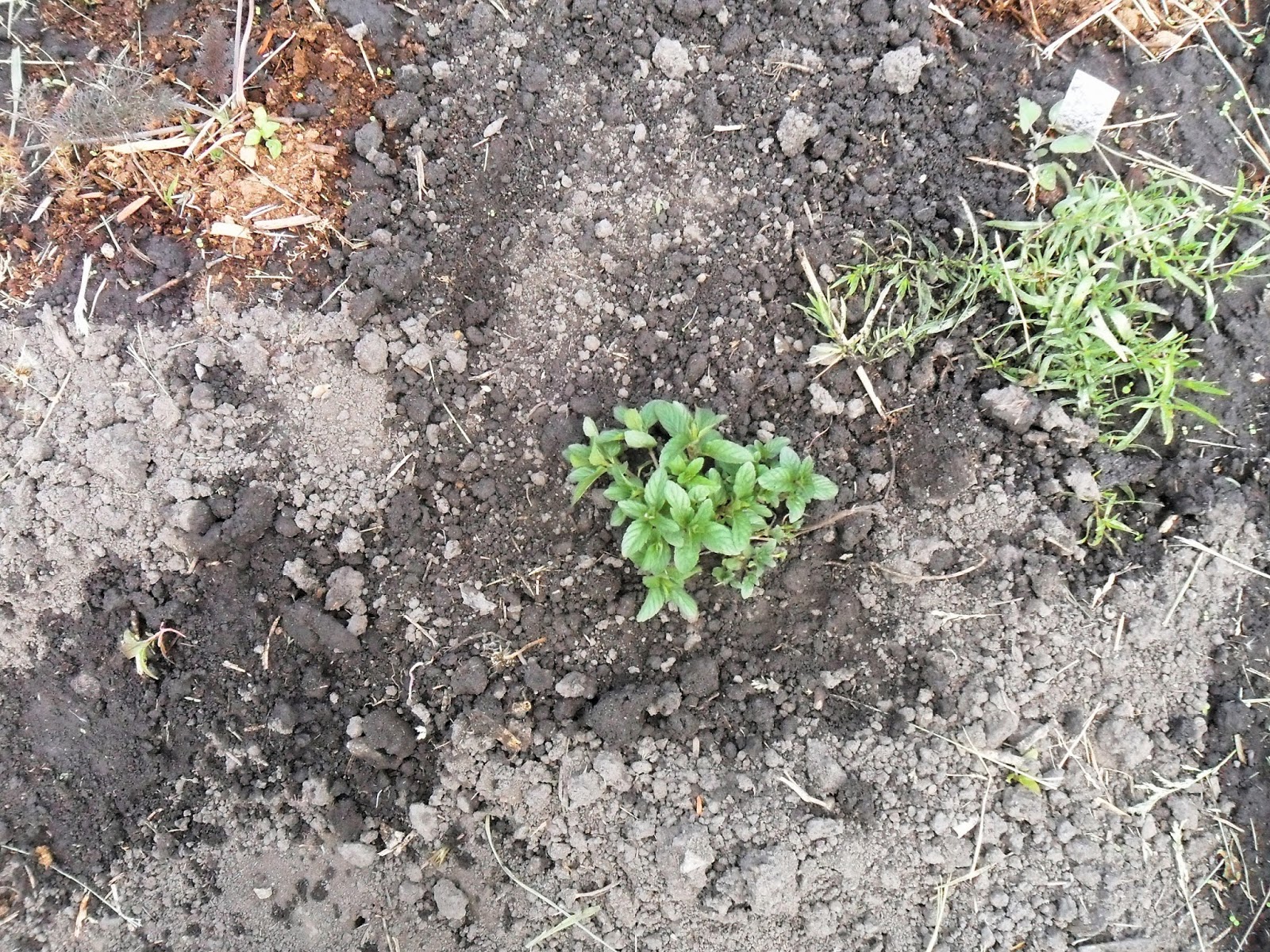
The spearmint was was on the edge of the path in the middle of the garden, so I thought it might get trampled and needed to be relocated.  I dug out out with the shovel.


Then I dug a hole where I wanted it (in the herb bed) the slightly bigger than the shovel.  I placed water and compost in the hole.

Then placed the plant in the hole, loosening the dirt around the roots just a bit.  Then a give it a good watering after firming the soil around the plant.  The key with transplanting is to take enough of the soil from the original location so that you are not tearing or damaging the roots of the plant.  They will be less shocked by the move if they travel with roots and original soil intact.

Spearmint in its new home next to the tarragon.  I guess I am assuming the tarragon will not grow much this season.

Saturday, May 24, 2014

Populate more Plants by Layering

I have a 20 x 20 community garden.  I purchased a number of plants, but being on a budget I wanted more plants than I could buy.  Several ways to handle this are to grow from seed, make cuttings from existing plants, or layer existing plants to create 'children.'

Italian Oregano  (Origanum x majoricum)
When I was planting the oregano I noticed that it had gotten a little leggy.  The late start to the season this year meant that plants stayed in small pots on the patio waiting to be planted far longer than normal.  In the case of the oregano instead of a compact low growing plant you normally see, it had long branches.  I decided I could use this "stretching," as it is called to my advantage by taking the legs or branches of the plant and rooting them to create new plants.  This technique is called layering.

Layering

Layering is taking the branch of an existing plant and without cutting it from the mother plant, bury it in soil and allow it to create a new root system.  Later you cut it from the mother plant and have a new plant you can transplant to another location in the garden.  The oregano with its long branches was perfect for this.  I planted the plant at an angle so the long branches laid along the soil.  I chose two longer healthy branches to use for layer and trimmed off the other long branches.  I used the clippings to make spaghetti sauce with that night.

You need a sharp knife or blade to do layering and sometimes a device to hold the branch down against the soil.  I keep my clippers very sharp for cutting herbs so this was the perfect tool to use for this task.  I made a slit in the bottom side of the branch.  The slit was then laid in the dirt and covered with soil.


Because the soil is rich and dense and the plant was placed at an angle to begin with, I did not need anything to hold the branch down in the soil.  However, if you are using an established plant and bending the branch down to the soil against its desire to reach toward the sun, a bit of help will be needed to hold the plant down.  A bent paperclip or hairpin work wonders.


I chose to layer two different branches on this oregano plant.  Once the soil was in place I gently watered it, being careful not to wash away the soil covering my cut area.   I then trimmed all the reaming long branches to keep the plant bushy and to give these two longer branches less competition for nutrients.  Still connected to the mother plant, these branches will get extra food from that plant until they develop a root system of their own.  This should take about 2 weeks.  It is important to keep the soil moist to encourage the root growth.


You can see the two branches lying in the soil and the mother plant, now trimmed.  In a week I will revisit this so you can see the signs it is working.

More about Italian Oregano

  • Light: Full sun to part shade
    Type: Perennial in zones 5 to 10
    Planting time: Spring, fall
    Features: Strongly aromatic and flavorful, dark green leaves, small white flowers
    Soil: Moist but well drained, pH 6.5 to 8
    Plant spacing: 12 to 18 inches apart
    Plant size: 12 to 18 inches tall
    Garden use: Herb garden, containers
          Plant use: Major ingredient in Italian cuisine

  • Savor classic Italian cuisine with the flavorful leaves of this oregano. An easy-growing plant for the garden or container, Italian oregano hails from the Mediterranean region. It thrives with lower humidity and well-drained soil. In the garden, use this oregano as an edging plant. Plants spread when happy, rooting along the stems. Harvest leaves or stems anytime during the growing season. Flavor is most intense just before plants flower. Trim plants often to keep flower formation at bay.

Friday, May 23, 2014

How to plant nursery plants

Most of the plants I placed in the garden came from a nursery.  I also have some winter sown seedlings that I will plant next week so i will talk about those then.  I also am going to grow some plants from seed.  That discussion will be in a day or so.

For today we are going to talk about how to give a nursery plant a good home so it will thrive in your garden.


These are the plants.  I obtained them from four places.  A couple I acquired at the Home Depot.  These are in peat pots from Bonny Plants.  I got basil and lemon balm on a whim when i was searching for a new patio pot.  Most came from the Herb and scented plant sale at the Oak Park Conservatory.  The Herb sale is their big fund raiser, although they do not have many herbs anymore I still support the sale and there are a few items you can only get there which I return each year for.  Several of my tomato plants, a few herbs and the cucumbers all came from the Conservatory.  I stopped at the Good Earth Nursery on my way home from the herb sale and got a few heirloom tomatoes, root celery, and a couple more herbs plants.  Luurs Garden Shoppe, which is my local nursery, less than two miles from the apartment is where I always get my potting soil, compost and other supplies like that, I picked up several thyme plants from them.  They stock an amazing selection of perennials and I cannot wait to shop there when I finally move out of the apartment!  I also won 4 broccoli plants at the garden club meeting in April.

So first things first.  The soil must be ready to be worked.

I laid out the garden with the plants still in their pots to make sure there was space.  I referred to notes, plant stakes and my own research to determine plant spacing.  Once I knew where I was placing the plants then I could dig holes.  Never take the plants out of the pots and leave them laying on the ground with bare roots.  They will dry out so quickly in the sun and the stress to the plant can be catastrophic.  All plants suffer from transplant shock adding dry roots to that and you can kill some less hardy plants.


Using a trowel or shovel, I like a hand shovel, dig a hole that is twice the size of the root ball of the plant you are planting..  This is my ergonomic shovel and I can dig with this all day without straining my wrist.  I admit this is an older tool, I have had it for years using it in my herb garden.   Use a ruler to measure over from the center of the hole to make the next hole when planting multiple plants. 


Toss a handful of compost into the bottom of the hole and water the hole liberally. This is a pepper plant so I just added some mushroom compost.  Organic materials like peat moss, composted grass clippings or plant material would also be perfect.  You just want to give them a bit of a food boost.


Then plant the plant, firming the soil around the plant with your hands enough to keep the plant upright and  the soil from washing away from the plant when it rains or the plant is watered, but not so firm that you press out all the air pockets around the plant.  Remember plants breathe from the roots so spaces in the soil for air are needed. Water the plant well after planting, then move to the next plant.  This is a bush cucumber.  

I place the plant tags that came with the plants in the soil near them.  I will eventually replace these with a larger, easier-to-read tag, but for now, it will keep them identified and allow me to remember what is what.  If it did not have a nursery tag, I wrote the name of the plant on a Popsicle stick and put that in the ground instead.

I put a top dressing of peat moss around the plants as a first layer of mulch to help the soil hold moisture.  I may add more mulch later.  I am waiting to see how the soil sheds water and if I need mulch for weed control. There is a lot of "unknown" in a Community Garden the first year.  In your own yard you will have a better grasp of the soil needs and quirks.

That is it, there is no other technique needed to plant these vegetables and herbs.  Just keep in mind that certain plants, like squash, are grown in a hill rather than on flat ground.  You mound up the dirt and place the plant in the center of the hill or if growing from seed you place three seeds in a hill and thin to one plant once they germinate and grow.

Here are  three planted hills of Zucchini.  I am growing that from seed.

Next time I will demonstrate layering.
.

Thursday, May 22, 2014

Garden Planted!

I had a plan to plant on May 9.  Instead we had downpours that resulted in soil too wet to plant in.  Then I had to wait a week due to a turn in the weather.  I was finally able to plant on Sunday, May 18.  It was in the 80s that day, but had been cold and snowing just two days previous.  It was still a risk to put plants in the ground with our changeable weather, but I went ahead and planted plants and seeds in an all day marathon.

Time wise (so you can compare)  I was able to get the plants and seeds in the garden in about 3.5 hours.  I started around 10 am and worked until about 1:30 with a break for lunch around noon.  That included planting and watering.  I spent another hour on that day placing some peat moss around some of the plants and rewatering so that would not blow away.

I had to rake out the weeds that were sprouting int he space, but did not need to till the soil,m as the park district did that.

Here are some images of the work:


Plot #72 with a few planting areas marked with flour.
The final garden plan (as designed)  This is subject to change during planting, but I had a rough idea of what I wanted to do using this plan I created in advance.
Tools: shovel and rake; watering cans; hand tools including trowels, hand rake, and ruler; plant markers, clip board with plan; brown paper bag with seed packets; cooler with water and snacks.
The plants mixed in two flats and an extra two cardboard boxes
The first thing I did was mark the handle of my rake with markings ever two inches for 1 foot, then 6 and 12 inch increments after that.  Now I just lay it down on the ground and  can easily space plants.

You can see how close the RR tracks are!  This is before work began, nothing raked or placed.

After raking a good portion of the plot (20 feet by 20 feet) I then placed out the plants based on the plan to see if everything would fit as desired.
We have way more tomato plants that originally planned, so that changed the diagram.  We also put in a few more paths that I planned too to make it easier to get in and take photos for future blogs.

That portion int he middle which is not raked is for seeds I did not intend to plant on that day, so I chose not to rake it until I was finished planting the other areas.

Here is a sneak peak of the completed planting, I will provide details of the how we got to this point in another post.


Monday, May 5, 2014

Ready to plant the Community Plot

I could get into my 20 x 20 foot Community Patch as of May 1, however my teaching schedule made that date not work for me.  The weather did not cooperate either as May 1 was cold and blustery.

I knew others would be able to get into the gardens before I could so I stopped over the day before to string off my space and mark a few places where I was going to plant seeds and plants.  Over the weekend I when plant shopping. Here is what I purchased:

  •  Peppers: Jalapeno and Pablano
  •  Tomatoes: Grape Tomatoes, Sweet 100, Mortgage Lifter and heirloom Tomato plants: Pineapple and Cherokee Purple
  •  Cucumbers: Burpless and Salad Bush
  •  Salad Greens: bib lettuce, arugula, red leaf lettuce, red stem sorrel, giant red mustard
  •  Broccoli                                                
  •  Acorn squash
  •  “Brilliant” Root Celery
  •  Yellow Sweet Spanish Onions
  •  Herbs: lemon balm, spearmint, lemon grass, bronze and green fennel, spicy globe basil, lemon basil, sweet basil, sunset hyssop, many varieties of thyme, tricolor sage, oregano,

The weather is going to be warm this week, so I have decided since the last frost free day is between May 10 and May 15 depending on who you listen to, that I will plant the bulk of the perennial herbs and some cold hearty herbs and vegetables as well as a number of seeds on May 9th.  I may save the tomatoes, cucumbers, and basil until the following week.

This was the originally garden plan I created while working with my books.  I got so caught up in placing things I forgot to pay attention to scale:

 
one square = 1 foot (it was seeing 6 feet of lettuce that I realized my mistake!)

This is what I finally decided on, the spacing is much more accurate and I left myself enough spaces for late additions and whimsey!
scale 1 square=1 foot (now the greens includes more than lettuce!)
I will detail the plot and the plants placed with close up shots after they go in.  This garden is going to have lots of items to can, dry, preserve and share!